Australia: Mining licence process map
What is the process for awarding mining rights in Queensland and Western Australia? What steps must a company and the government follow?
These ‘maps’ present the process as a step-by-step guide. They shed light on a process that is often complex and complicated, rendering it more transparent.
Their purpose is to help stakeholders – whether they be from government, industry or civil society – to identify points within the process where transparency and public accountability need to be strengthened, if corruption risks are to be reduced.
Increasing the transparency and public accountability of the process has the benefit of not only reducing corruption risks but increasing public trust and confidence in that process.
As mining licence processes differ across Australian jurisdictions, these maps focus on the mining-rich states of Queensland and Western Australia.
Visit the Australia Country page

Mining lease process in Queensland
This process map describes the steps involved in applying for a mining lease to extract and sell minerals in Queensland.
Queensland is one of the largest mining jurisdictions in Australia. Mining made up the largest contribution to the Queensland economy, accounting for 11.7% ($38.6 billion) in 2019/20. Queensland's coal and bauxite reserves are some of the largest in the world, and it has supplied natural gas and minerals to around 91% of the value of Queensland overseas exports.
Before a mining lease is granted in Queensland, mining applicants need to satisfy a number of related approval requirements, for example, environmental approvals, native title and Aboriginal cultural heritage agreements, compensating private landowners and addressing any objections to the application.
A mining lease may also include authorisation for activities associated with mining – such as infrastructure to support mining operations, the processing of minerals, tailings dams, various types of water storage or treatment plants and rehabilitation and remediation associated with these activities.
The Queensland Department of Resources is responsible for assessing all mining lease applications.

Mining lease process in WA
This process map describes the steps involved in applying for a mining lease to extract and sell minerals in Western Australia (WA).
In the 2020 Fraser Institute survey of mining companies, WA ranked number 4th for investment attractiveness globally. WA is the main exporter of minerals and metals in Australia, accounting for 55% of Australia's mining gross value added in 2019–20. WA's mining accounted for 30% of WA's gross state product in 2019–20. Iron ore accounted for 60% of WA minerals produced in 2019–20, and in 2019 WA contributed 37% globally to iron ore production. Other minerals mined in WA include gold, natural gas, bauxite, nickel, base metals and lithium.
Before a mining lease is granted in WA, mining applicants need to satisfy a number of related approval requirements. These can include environmental approvals, native title and Aboriginal cultural heritage agreements, compensating private landowners and addressing any objections to the application.
The WA Department of Mines, Industry Regulation and Safety (DMIRS) is responsible for assessing all mining lease applications.
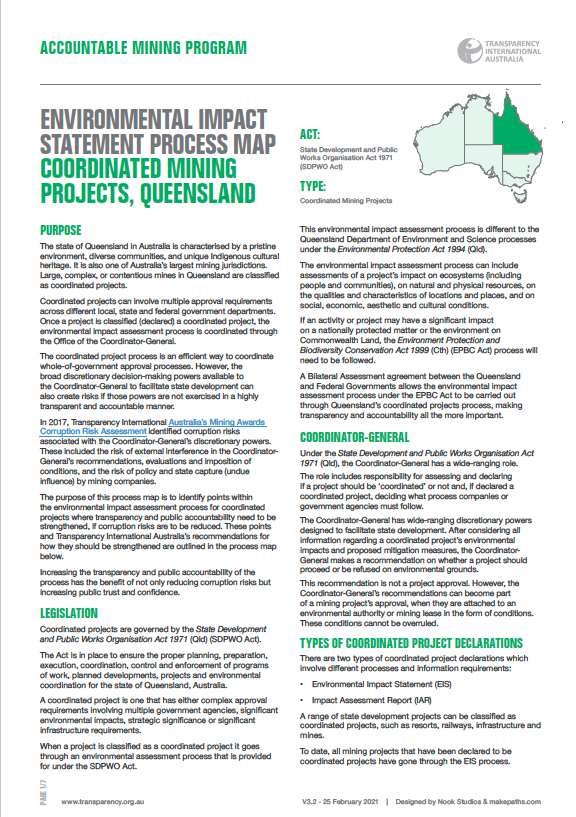
Environmental Impact Statement Process for coordinated mining projects in Queensland
This process map describes the steps involved in the environmental impact statement (EIS) process for coordinated mining projects in Queensland.